How to Start a Bullet Journal: A Beginner's Guide for India
Every October, a lot of us reach for a fresh notebook. Diwali is round the corner, the year is winding down, and there's a quiet urge to get organised before the next one begins. If you've seen beautiful journal spreads online and wondered how to start a bullet journal without spending a fortune on supplies or hours on lettering, this guide is for you. You'll learn the four pages that make the system work, the symbols to use, what you actually need to buy in India, and a simple 20-minute setup you can do this evening with one notebook and one pen.
What is a bullet journal, really?
The Bullet Journal is a notebook-based planning method created by designer Ryder Carroll, who describes it on the official Bullet Journal website as a way to "track the past, order the present, and design your future." It works as a to-do list, diary and planner rolled into one book.
The key idea is rapid logging: instead of writing long sentences, you jot short entries with a symbol in front of each. A dot is a task, a dash is a note, a circle is an event. That's it. The elaborate watercolour spreads you see on Instagram are optional decoration, not the method.
Why paper, when there are a hundred apps?
Writing by hand slows you down just enough to think about what you're writing. A 2024 EEG study of 36 university students in Frontiers in Psychology found that handwriting produced far more widespread brain connectivity than typing, in patterns linked to memory and learning. Separately, research in the Journal of Personality and Social Psychology found that making a specific plan for an unfinished goal reduced the intrusive thoughts it caused. In plain words: writing a task down, with a plan, helps your mind let go of it.
What you need to start a bullet journal in India
Very little. Here's an honest supplies list, from essential to "only if you want to."
| Item | Do you need it? | What to look for |
|---|---|---|
| One notebook | Essential | A5 size, at least 100 pages, paper thick enough that ink doesn't bleed. Plain (unruled) gives you the most freedom; ruled works fine for list-lovers. |
| One pen | Essential | Any pen you enjoy writing with. Black or blue keeps things calm. |
| A pencil and ruler | Helpful | For drawing calendar grids and trackers on plain pages. |
| Two or three coloured pens | Optional | Useful for colour-coding work, home and health. |
| Stencils, washi tape, stickers | Optional | Fun, but skip them until the habit sticks. |
A good starter kit can cost under ₹100. The bullet journal you actually use beats the expensive one you're scared to write in.
Plain, ruled or dotted?
Dotted notebooks are popular for bullet journaling because the dots guide lines without dominating the page. But they're not required. A plain page with a pencil grid works just as well for calendars and trackers, and a ruled page is perfect if most of your journal will be lists and notes. If you're unsure about size too, our guide on choosing between A5 and B6 notebooks walks through the trade-offs.
The bullet journal key: symbols that do the heavy lifting
Your key is a small reference on the first or second page explaining your symbols. Start with the classic set and add your own later.
- • Task (something to do)
- × Task completed
- > Task migrated (moved to a later day or month)
- < Task scheduled into the future log
- ○ Event (a meeting, a birthday, a puja)
- – Note (an idea, a fact, something to remember)
- * Priority, written before any bullet
Keep it to these seven for your first month. Many beginners overload their key and then forget what a triangle meant.
How to start a bullet journal: the 20-minute setup
Here is a step-by-step setup for a brand-new notebook. Put the kettle on; this takes about as long as a cup of chai.
Step 1: Number your pages (3 minutes)
If your notebook isn't numbered, number the first 20 or so pages now and keep going as you use them. Page numbers make the index work.
Step 2: Create the index (2 minutes)
Title pages 1–2 "Index." Every time you create a new collection, such as "November" or "Books to read," write its name and page number here. This is how you find things later without flipping through the whole book.
Step 3: Draw your key (2 minutes)
On the next page, copy the symbols above. Leave space to add more.
Step 4: Set up a future log (5 minutes)
The future log is a bird's-eye view of the coming months. Divide the next two pages into six boxes, one for each month from November to April. Add birthdays, exams, Diwali and Christmas plans, work deadlines and trips. When something comes up months away, it goes here.
Step 5: Make your monthly log (5 minutes)
On the left page, write the dates of the month down the margin with the day initial (1 S, 2 M, 3 T…). Add events beside each date. On the right page, list the tasks you want to tackle this month. Don't fill it with everything you've ever wanted to do; pick what matters.
Step 6: Start your first daily log (3 minutes)
Write today's date and rapid-log what's on your plate: tasks, events and notes. Tomorrow, start a new daily log right below wherever today's ended. No blank pages reserved, no wasted paper.
Migration: the habit that makes it work
At the end of each month, look back at every open task. For each one, ask: does this still matter? If yes, migrate it (mark it with > and rewrite it in next month's log). If no, strike it out. Rewriting by hand creates a gentle friction, so tasks that aren't worth rewriting quietly drop off. This monthly review is the heart of the method, and it's where many people find the real calm.
Easy bullet journal ideas for your first month
Once your core pages are in place, add one or two collections. Some that work well for Indian students and young professionals:
- Habit tracker: a simple grid with dates across the top and habits down the side, such as water, a 20-minute walk, reading, no phone after 10 pm.
- Exam or study tracker: list subjects and chapters, then tick them off as you revise. Handy for semester exams in November and December.
- Diwali planner: guest list, gift list with budgets in ₹, cleaning schedule, sweets to order.
- Expense log: a running list of daily spends to spot where the money goes (hello, food delivery).
- Gratitude or one-line-a-day page: a short note each night. If you'd like to go deeper, try our guide to reflective journaling for beginners.
Mistakes beginners make (and how to avoid them)
- Chasing perfect pages. Your journal is a tool, not a portfolio. Crossed-out lines are proof it's working.
- Setting up too many trackers. Start with one. Add more only if you keep using it for two weeks.
- Skipping the monthly review. Without migration, it's just another to-do list.
- Abandoning it after a missed week. Write today's date and carry on. There's no catching up to do.
Notebooks and pens for your first bullet journal
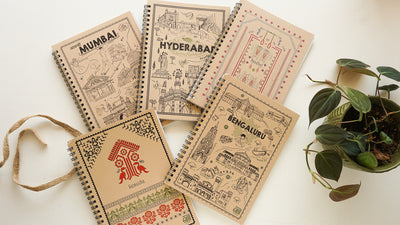
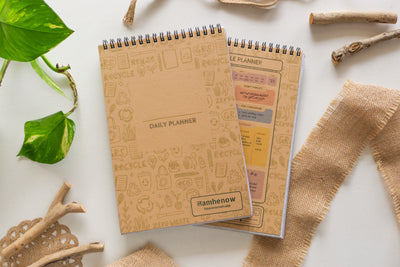
We make our notebooks from recycled paper at Lamhenow, and a few of them suit bullet journaling particularly well:
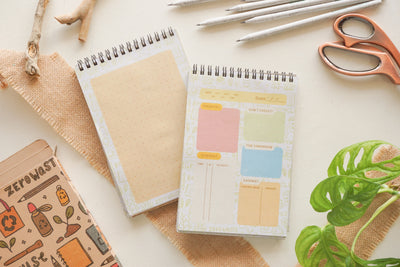
- Recycled Wiro Notepad A5: 100 pages of 80 GSM GRS-certified recycled paper, available in unruled (great for grids and trackers) or ruled, from ₹35. The wiro binding lets it lie flat while you draw.
- Lamhenow Journal: 160 pages of 80 GSM GRS-certified recycled paper, enough room for a full year of monthly logs and collections. It's also available bundled with pens or pencils.
- Pens & Pencils: including paper pens made with recycled paper and pencils made from newspapers, for sketching grids before you ink them.
Browse the full range in our diaries and journals collection.
Frequently asked questions
Can I bullet journal in a ruled or plain notebook?
Yes. The method only needs a notebook and a pen. Dotted pages are popular because they help with grids, but plain pages with a light pencil guide work just as well, and ruled pages suit people who mostly write lists and notes. Choose paper thick enough that your pen doesn't bleed through.
How much time does bullet journaling take each day?
About five to ten minutes. Most people spend a few minutes in the morning listing tasks and a couple of minutes at night ticking things off and adding notes. The monthly setup and review takes around 20–30 minutes. Decorative spreads take longer, but they're entirely optional.
Is bullet journaling good for students?
It can be very useful. A future log keeps exam dates and assignment deadlines visible, a study tracker shows which chapters are done, and daily logs break revision into small tasks. Because it's paper-based, it also keeps you off your phone while planning, which helps many students focus.
What should I put on the first page of my bullet journal?
Most people start with an index on the first one or two pages, followed by a key explaining their symbols, then a future log covering the next six months. After that comes the current monthly log and your first daily log. You can add a personal title page before the index if you like.
What if I miss days or weeks?
Simply write today's date and start a new daily log. There's no need to fill in missed days or leave blank pages. At your next monthly review, migrate any tasks that still matter. Flexibility is one of the method's biggest strengths compared with dated diaries.
Start small, start today
You don't need the perfect notebook, a set of brush pens or a free Sunday. You need one page, today's date and a few dots. Set up your index, key and monthly log this evening, and let the system grow with you. When you're ready, pick up a recycled paper journal from Lamhenow; shipping is free on every order, with no minimum.